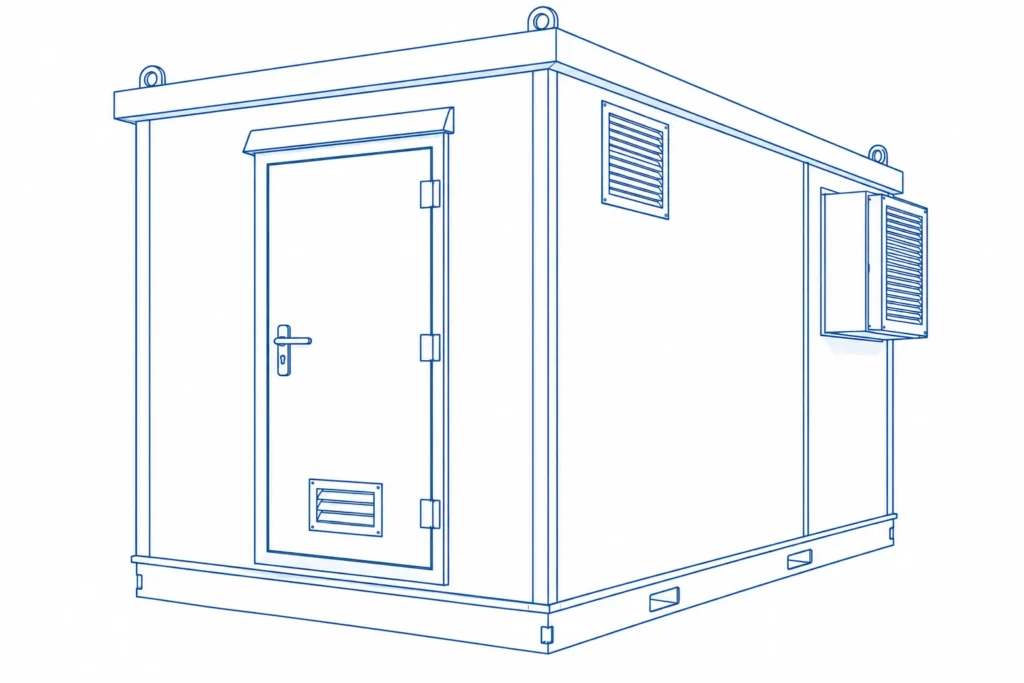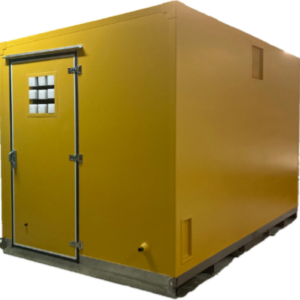


A technical shelter is a structure designed to house and protect technical or industrial equipment. Depending on the needs, it can shelter instruments, analyzers, cabinets, or other equipment requiring protection adapted to their installation environment.
Installed indoors or outdoors depending on the project, the shelter can be custom-designed to accommodate the equipment it needs. Dimensions, materials, insulation, openings, and interior layout are all parameters that can be considered during its design.
Specializing in cabins, shelters, technical shelters and protective canopies, Gensollen designs in particular technical shelters in polyester or sheet metal adapted to the constraints of industrial applications.
What is a technical shelter?
A technical shelter is an enclosure or structure designed to create a protected space around one or more pieces of equipment.
The English word shelter means “shelter”. In the industrial field, the term generally refers to a structure designed to protect technical equipment and provide it with an environment suitable for its operation or use.
A technical shelter can therefore accommodate different types of equipment: measuring instruments, analyzers, cabinets, electrical installations, telecommunications equipment or other industrial systems.
This is not necessarily a standard product. The design can be adapted to the dimensions of the equipment, its location, the installation site and the various constraints of the specifications.
According to the project, a shelter can also include a floor, insulation, electrical equipment, ventilation, air conditioning or various interior fittings.
This adaptability explains the use of customized technical shelters in many industrial environments.
What is the purpose of a technical shelter?
The primary function of a technical shelter is to protect the equipment it contains from its external environment.
Industrial instruments can be sensitive to various stresses: humidity, dust, inclement weather, temperature variations, or even corrosive environments. The level of protection required, however, always depends on the installation and the equipment involved.
The shelter also allows several components to be grouped together in the same technical space.
In an analysis or instrumentation application, for example, different equipment can be integrated within the same cabin to form a coherent unit.
This approach allows the enclosure to be designed around the equipment to be installed rather than having to adapt the equipment to a standard structure later.
The industrial technical shelter then becomes an integral part of the installation.
What are the characteristics of a technical shelter?
There is no single technical shelter configuration applicable to all projects. Its characteristics depend in particular on the equipment to be housed, its location, environmental conditions and the technical constraints defined in the specifications.
Equipment protection
The structure forms a first barrier between the equipment and its environment. Depending on its design, it can help protect the equipment against weathering, humidity, dust, or certain aggressions related to the installation environment.
The desired level of protection must be defined for each project.
Some Gensollen shelter cabins, for example, offer specific protection levels such as IP65 and IK10 mechanical resistance. However, these characteristics must be associated with the models and configurations for which they are intended and do not automatically constitute the performance of all technical shelters.
Insulation and control of the indoor environment
Some equipment also requires limiting heat exchange with the outside.
The shelter can then be designed from an insulated structure. In some Gensollen polyester solutions, the construction relies in particular on sandwich panels combining a fiberglass-reinforced polyester skin and polyurethane foam insulation.
Depending on the project constraints, this insulation can be complemented by ventilation or air conditioning solutions.
The objective is to design the building envelope according to the conditions required by the equipment installed inside.
Equipment layout and integration
A technical shelter is not necessarily limited to an empty shell.
According to the specifications, Gensollen can also intervene on the fitting out of the cabins, the integration of the equipment and the electrical wiring.
The shelter can therefore include, depending on the project, shelves and supports, cable passages, electrical equipment, ventilation grilles, ventilation, air conditioning or even sampling equipment.
The interior layout can be studied taking into account access, operation and maintenance constraints.
This is one of the main advantages of a custom-made technical shelter: to simultaneously design the building envelope and the layout of the equipment it must house.
Technical shelter made of polyester or sheet metal: which to choose?
The choice of material is one of the essential parameters of a shelter project.
Gensollen specializes in cabins and shelters made of polyester or sheet metal. The appropriate solution depends on the technical and environmental constraints of the project.
Therefore, there is no material that is systematically superior to another.
The technical shelter made of polyester
Fiberglass-reinforced polyester is particularly interesting for the production of structures intended for certain industrial environments.
Gensollen uses this material in particular to manufacture cabins and shelters from insulated sandwich panels.
Polyester is also of interest in environments where corrosion is a significant constraint.
The panel design allows the outer envelope and thermal insulation to be combined in a single structure.
Polyester shelters are therefore a solution to consider when the characteristics of the material correspond to the constraints of the project.
The sheet metal technical shelter
Gensollen also produces sheet metal solutions.
The choice of a metal construction may meet other requirements related to installation, dimensions, mechanical constraints or the overall design of the project.
Rather than choosing the material independently of the rest of the project, it is better to integrate this decision into the analysis of the specifications.
Polyester or sheet metal: the right technical shelter is first and foremost one whose design corresponds to the environment and the equipment it must protect.
In which sectors is a technical shelter used?
The need for protection and integration of equipment exists in many industrial activities. Gensollen operates particularly in the fields of analysis and instrumentation, Oil & Gas, rail and telecommunications.
Analysis and instrumentation
Analytical equipment and measuring instruments may require specific protection from their environment. The shelter creates a dedicated space where the equipment can be installed and, depending on the project, equipped with insulation, ventilation, air conditioning, or electrical systems.
Oil & Gas and Industrial Environments
Some industrial facilities impose significant environmental, corrosion, or safety constraints. The shelter must then be designed according to the precise requirements of the facility. When the project concerns an area subject to specific requirements, such as an ATEX zone, these must be identified during the design phase. An installation in an ATEX environment entails specific constraints and does not automatically qualify any shelter as an “ATEX shelter.”
Railway
In the railway sector, technical equipment may need to be installed and protected near infrastructure. A shelter or technical cabin then provides an enclosure adapted to the equipment and its installation environment.
Telecommunications
Telecommunications equipment installed outdoors also requires appropriate protection solutions. A technical shelter or enclosure can be designed to house the equipment while providing the access points, cable routing, and other necessary infrastructure for its operation.
Technical shelter, technical cabin and technical shelter: what are the differences?
The terms technical shelter, technical cabin and technical shelter are similar and can sometimes be used to refer to similar solutions.
The term shelter primarily emphasizes the protective function. It is widely used in industrial and technical sectors.
The technical cabin generally refers to an enclosed space that can house equipment and various interior fittings.
Technical shelter is a more general French formulation which also emphasizes the protection of an installation.
The protective canopy follows a slightly different logic: it can protect an installation without necessarily forming a completely enclosed space.
These differences in vocabulary are nevertheless secondary when it comes to designing a project.
The essential question remains: what equipment needs to be protected, against what constraints and under what conditions?
It is from these elements that the type of structure, its dimensions, its material and its level of development can be determined.
How to design a custom-made technical shelter?
The design of a custom-made technical shelter begins with a precise analysis of the need.
The dimensions of the equipment and the shelter must first be defined. Then, the installation conditions and constraints to which the entire system will be exposed must be identified.
The choice of polyester or sheet metal can then be made according to the desired characteristics.
The study must also take into account any potential needs for insulation, ventilation, air conditioning and power supply.
The interior layout is another important step.
Doors, openings, supports, cable passages and spaces required for maintenance operations should ideally be anticipated before manufacturing.
For complex projects, this approach makes it possible to obtain a shelter cabin truly designed around the equipment it will house.
Why choose Gensollen for a technical shelter?
Gensollen specializes in cabins, shelters, technical shelters and protective canopies made of polyester or sheet metal.
The company has over 40 years of experience serving industry and is involved in applications related to analysis and instrumentation, Oil & Gas, rail and telecommunications.
Its activity is not limited to the manufacture of the envelope.
Depending on the project requirements, Gensollen can also take into account cabin layout, equipment integration and electrical wiring.
This approach allows us to work from the specifications to determine the dimensions, material, insulation and equipment needed.
Discover Gensollen shelter cabins and the solutions offered by Gensollen .
The polyester cabin projects also allow us to observe concrete applications of the company’s know-how.
For a technical shelter project, the Gensollen team can study the specifications in order to define a solution adapted to the equipment and constraints of the installation.
A technical shelter is a structure designed to house and protect technical or industrial equipment. It can be custom-designed according to the equipment, the installation environment, and the project constraints.
Its main purpose is to create a protective enclosure around industrial equipment. Depending on its design, the shelter can also incorporate insulation, electrical equipment, ventilation, air conditioning, or various other features.
The two terms can refer to very similar solutions. “Technical shelter” is a term commonly used in industry, while “technical shelter” is a more general French term. The actual characteristics of the structure remain more important than its name.
Yes. A technical shelter can be sized and fitted out according to the equipment it needs to house. The materials, insulation, openings, and various interior fittings can also be adapted to the specifications.
Yes. A technical shelter can be sized and fitted out according to the equipment it needs to house. The materials, insulation, openings, and various interior fittings can also be adapted to the specifications.
Yes, when it is specifically designed for the conditions of its installation site. The materials, protection, insulation, and any equipment must then be determined according to the external constraints to which the shelter will be exposed.
Conclusion
The technical shelter provides a protection and integration solution for numerous industrial equipment. More than just an enclosure, it can be designed according to the equipment it houses, its installation environment, and the specific constraints of each project.
Polyester or sheet metal, dimensions, insulation, openings, ventilation, air conditioning and interior layout are all parameters that can be taken into account in the design of a custom-made technical shelter.
With its experience in manufacturing cabins and shelters for industry, Gensollen supports projects from the definition of the need to the realization of the solution adapted to the specifications.