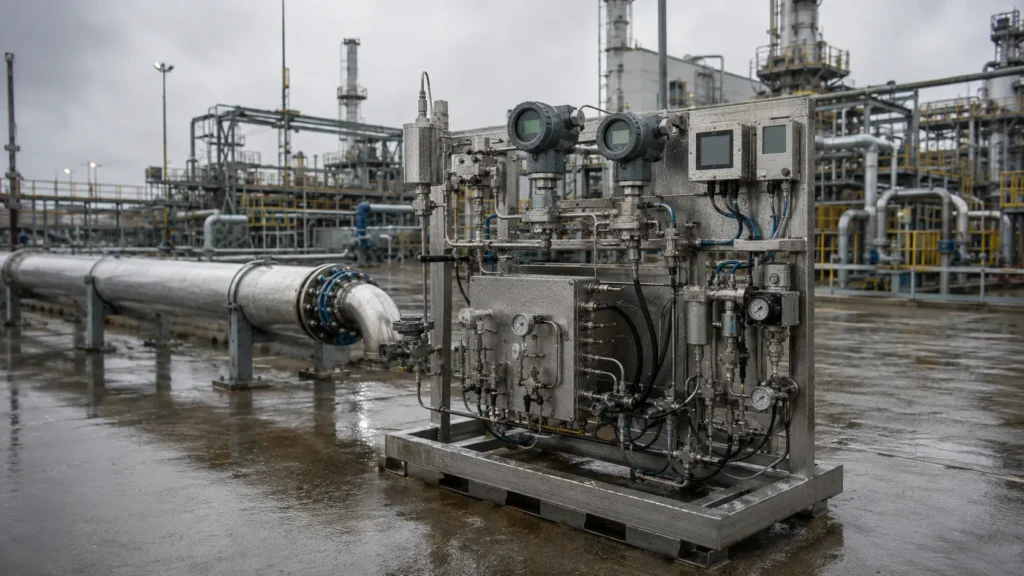


The IP paradox: a false sense of security
On most industrial projects, the protection of outdoor equipment begins with a simple requirement: a high IP rating. IP65, IP66… the reflex has become almost automatic.
On paper, it makes sense. The IP code indicates resistance to water and dust. It’s a common language between designers, buyers, and installers.
But in practice, this reasoning quickly shows its limitations.
A perfectly sealed cabinet can become a closed system subject to thermal cycles. When the temperature drops, the internal air reaches its dew point. Humidity then forms… inside the cabinet itself.
This internal condensation phenomenon is the cause of a large proportion of breakdowns in analytical equipment.
And that is precisely where the paradox lies:
The IP code does not cover this risk.
It also does not cover:
- Corrosion
- UV radiation
- Chemical atmospheres
- Phenomena related to thermal cycles
In other words, an IP66 cabinet can be perfectly compliant… and yet unsuitable for the real environment.
The 3 main risks that actually cause breakdowns
The list of environmental constraints in technical documents is long. In practice, experience shows that three phenomena account for the majority of failures and maintenance costs.
1. Internal condensation
This is the most critical and most underestimated risk.
It appears without any visible signs, often after several thermal cycles. It deposits itself on components, connections, and circuits.
Its effects are gradual:
- Internal corrosion
- Insulation defects
- Measurement instability
This is typically the type of problem that is not detected immediately but degrades performance over time.
2. Corrosion
It is highly dependent on the environment: industrial sites, saline areas, air pollution.
Contrary to popular belief, it does not only concern metallic parts. It also affects interfaces, assemblies and connections.
It translates to:
- Material degradation
- Loss of connection reliability
- Increase in maintenance interventions
3. Overheating due to solar radiation
An outer envelope exposed to the sun functions as a closed thermal volume.
Without proper management, the internal temperature can drift significantly.
Consequences :
- Instrument drift
- Accelerated aging
- Unwanted triggering
These three risks should not be analyzed in isolation. They are constantly combined:
Heat + humidity → condensation;
humidity + pollution → corrosion
It is this interaction that makes outdoor environments particularly complex.
What this implies for the integration of equipment
At this point, the question changes completely in nature.
It is no longer a question of choosing a shell, but of designing a controlled operating environment.
The equipment involved is varied:
- Process analyzers
- Transmitters
- Manifolds
- sampling canes
- Instrumentation boxes
- …
They all have one thing in common: they are sensitive to the magnitudes of influence.
Temperature, humidity, and mechanical stresses directly impact:
- measurement accuracy
- stability
- continuity of service
This is why a simple standard wardrobe quickly reaches its limits.
A suitable solution must integrate several dimensions simultaneously.
Thermal control
The goal is to control internal conditions, not simply to isolate.
This can involve:
- Ventilation
- Heating
- Air Conditioning
The choice depends on the context, but the objective remains the same: to avoid thermal drifts and limit condensation.
Internal organization
The placement of equipment has a direct impact on its operation.
We need to think about:
- Accessibility for maintenance
- Separation of sensitive areas
- Airflow management
Network management
The routing of cables and tubing is often a weak point in installations.
A suitable design allows for:
- to prevent moisture from entering
- to limit mechanical stress
- to facilitate interventions
In certain configurations, solutions such as raised floors can improve this organization.
It is precisely on this logic of integration that the solutions proposed by Gensollen are positioned: not only to contain the equipment, but to integrate it into an environment adapted to the real constraints.
One point of concern: ATEX environments
In certain sectors, particularly oil & gas or petrochemicals, the presence of explosive atmospheres imposes specific constraints.
These environments are subject to strict regulatory frameworks and require tailored solutions from the design stage.
This subject cannot be addressed by approximation. It must be tackled with the appropriate frameworks and a dedicated analysis.
Conclusion: Change your design logic
The main lesson learned on the ground is simple:
The breakdowns are not due to a lack of sealing.
They stem from a lack of control over internal conditions.
Focusing solely on the IP rating leads to a false sense of security.
The right approach is to ask the right questions from the outset:
- How will the temperature change inside the envelope?
- How will condensation be avoided or controlled?
- How will the materials react to the environment?
Based on these answers, the choice between a cabin, cabinet, box, or integrated solution becomes relevant.
And this is where the reliability of an outdoor environmental analysis system really comes into play.
Have a project in the development phase? Contact Gensollen